When bookmatching earns its place.
Two slabs opened like a book make a symmetry the eye finds immediately. That is exactly why it needs a wall that deserves the attention.
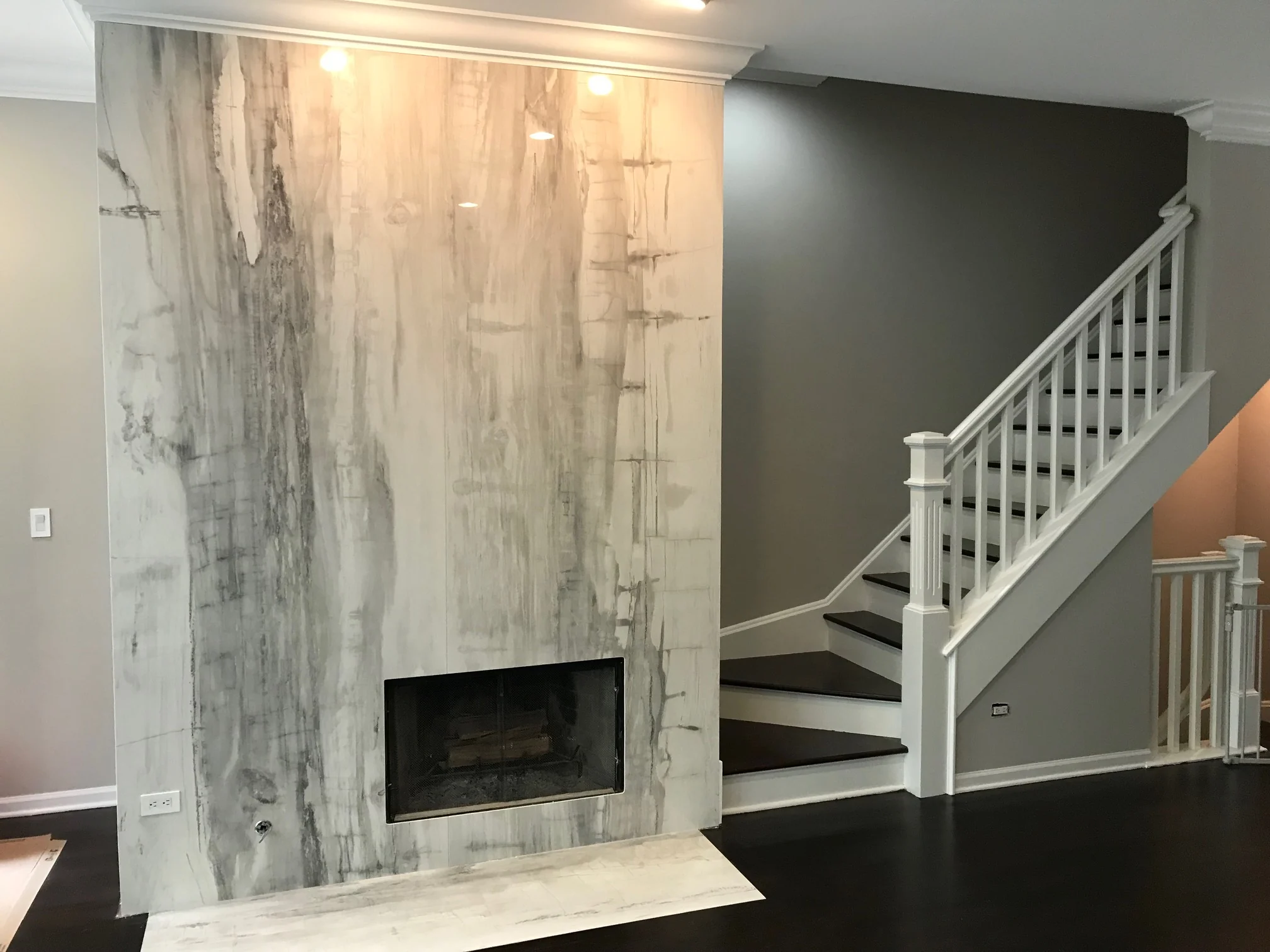
What bookmatching is
Bookmatching places two coordinated pieces side by side so the pattern mirrors across the joint. The result reads as one composition rather than two panels, and the center line becomes the feature.
It depends on suitable material and a planned layout. The pieces have to be intended to pair, and the design has to decide in advance where the mirror line falls.
The room decides
A mirrored pattern asks for a surface that can be seen whole — a fireplace, a feature wall, the face of an island, a reception desk. Rooms answer it best when the rest of the palette stays quiet.
On a wall broken by doors, sockets and shelving, the symmetry is interrupted before it registers, and the gesture costs more than it gives.
What it asks of the project
Plan the center line against the room, not only against the wall: a mirror that sits off-axis from a fireplace opening or a vanity will read as an error even when it is measured correctly.
Agree the layout on a drawing, with cut-outs, fixtures and joint positions shown. This is a detail to settle before fabrication rather than during it.
Alternatives worth considering
Where a room cannot carry a mirrored pattern, a continuous run of one character often does more. A quieter slab used generously can feel more considered than a dramatic one used twice.
Pattern direction alone is another option. Simply agreeing which way the veining runs across a space is a small decision with a visible result, and it costs nothing to make early.